.png)

Garmin Running Watches Explained: Which Garmin Is Right For You?
Garmin has become the benchmark by which most running watches are judged. Whether you're training for your first 5K, chasing a marathon personal best or preparing for an ultramarathon, there is a Garmin watch designed specifically for your goals. Few brands have invested as heavily in running technology, and that experience shows in both the hardware and the software.
Choosing the right Garmin, however, isn't always straightforward. The company offers several different watch families, each aimed at a slightly different type of runner. Some prioritise value, others focus on advanced training analysis, while some are built for trail running and extreme endurance. Understanding those differences is far more important than simply buying the most expensive model.
This guide reviews Garmin's current running watch range, explains what each family does best and helps you decide which model offers the best value for your running.

Why Garmin Leads The Running Watch Market
Garmin has built its reputation by designing watches specifically for athletes rather than adapting general-purpose smartwatches for sport. Every running watch focuses on accurate GPS tracking, dependable heart-rate monitoring, detailed training analysis and battery life that comfortably supports regular training.
Another reason Garmin remains so popular is its software ecosystem. Every compatible watch syncs with Garmin Connect, where you can review runs, monitor recovery, analyse long-term progress, build training plans and connect with platforms such as Strava. Unlike some competitors, the core Garmin Connect platform does not require a monthly subscription, making it one of the strongest long-term values in the running watch market.
Garmin also continues to improve its watches long after purchase through regular software updates. New training features are frequently added to existing devices, helping runners get more value from their investment over time.
Garmin Running Watches At A Glance
Garmin Watch | Best For |
Forerunner 70 | Beginners and new runners |
Forerunner 170 | Improving runners who want music and more training features |
Forerunner 570 | Regular runners, marathon training and triathlon |
Forerunner 970 | Serious marathon runners and performance athletes |
Fēnix 8 / Fēnix E | Trail runners, hikers and outdoor adventure |
Enduro 3 | Ultramarathons and extreme endurance events |
Instinct 3 | Rugged outdoor training and adventure sports |
Venu Range | Fitness, wellness and everyday use |
vívoactive 6 | Casual runners and all-round fitness |
Garmin Forerunner
If your primary focus is running, the Forerunner range is where you should begin. These watches are lighter than Garmin's outdoor models, comfortable enough to wear every day and packed with features designed specifically for runners.
The current range starts with the Forerunner 70, which provides the essential tools needed by new runners. GPS tracking, structured workouts, recovery guidance and straightforward navigation make it an excellent first running watch without overwhelming beginners with advanced metrics.
The Forerunner 170 adds more features for runners who train more frequently. Optional music storage, additional training insights and broader smartwatch functions make it a logical upgrade for those preparing for regular races or increasing their weekly mileage.
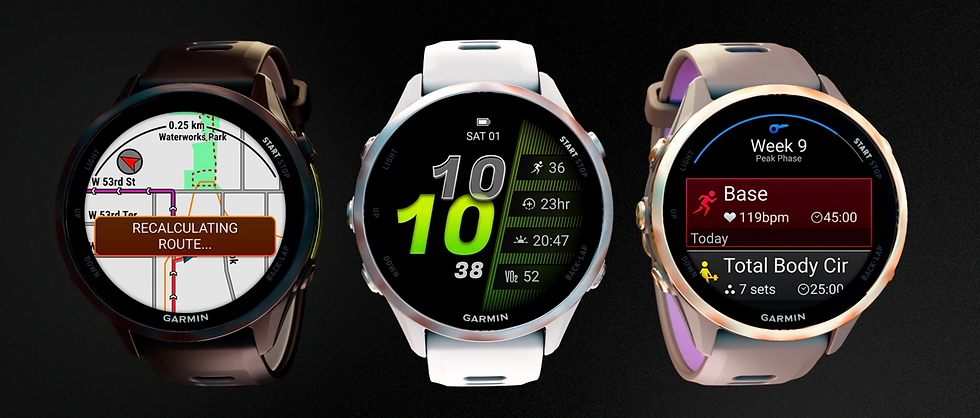
For many runners, however, the standout model is the Forerunner 570. It combines advanced training analysis, recovery tools, multi-band GPS and Garmin Run Coach with a lightweight design that feels equally at home during a marathon or everyday training. If someone asked me to recommend one Garmin watch for the majority of runners, this would almost certainly be it.
At the top of the range sits the Forerunner 970. This is Garmin's flagship running and triathlon watch, featuring premium materials, full-colour mapping, enhanced navigation, an integrated LED flashlight and Garmin's most advanced training features. It is an exceptional watch, but it is also expensive. Unless you regularly use mapping or enjoy analysing every available performance metric, the Forerunner 570 is likely to represent better value.
Garmin Fēnix
The Fēnix range has become one of Garmin's most recognisable watch families because it combines outstanding running features with serious outdoor capability. Built for runners who also hike, climb, cycle or spend time in the mountains, these watches offer exceptional navigation, rugged construction and impressive battery life.
They are heavier than the equivalent Forerunner models, but that extra weight reflects the more robust design and additional outdoor functionality. If your weekends are just as likely to involve a mountain trail as a road race, the Fēnix range is well worth considering.
For runners who rarely leave paved roads, however, the lighter Forerunner models generally make more sense.
Garmin Enduro 3
The Enduro 3 is designed for one purpose above everything else: going further without worrying about battery life. It is aimed at ultramarathon runners, multi-day adventures and endurance athletes who spend many hours away from a charger.
Alongside its exceptional battery performance, the Enduro 3 includes premium navigation, detailed mapping and advanced training features. For the average runner, it is probably more watch than necessary, but for ultra-distance athletes it is one of the most capable options Garmin has ever produced.
Garmin Instinct 3
The Instinct 3 takes a different approach by prioritising durability and reliability in demanding environments. It is popular with hikers, obstacle racers, military personnel and runners whose training regularly takes them off the beaten track.
Although it records running activities extremely well, it lacks some of the refinement and lightweight feel of the Forerunner range. If running is your main sport, a Forerunner is still likely to be the better choice. If your running forms part of a broader outdoor lifestyle, the Instinct 3 deserves serious consideration.
Garmin Venu And vívoactive
Not everyone wants a dedicated running watch, and this is where the Venu and vívoactive families come into their own. These watches place greater emphasis on health, wellness and everyday smartwatch features while still providing accurate run tracking.
The Venu range is ideal for people who split their time between running, gym sessions, walking and general fitness. The vívoactive 6 offers a similar experience at a more accessible price point, making it an attractive option for casual runners who want one watch for both exercise and everyday life.
Serious marathon runners will usually benefit from the additional training tools found in the Forerunner range, but many recreational runners will never need anything more.
Garmin Connect
One of Garmin's biggest strengths is not actually the watches themselves but the software that supports them. Garmin Connect brings together your activities, health information, recovery, sleep, personal records and training plans into one comprehensive platform.
The app also integrates with popular services including Strava and provides Garmin Run Coach, adaptive training plans, route planning and detailed performance analysis. The amount of information available can initially feel overwhelming, but it quickly becomes one of Garmin's greatest advantages once you become familiar with it.
If you'd like a more detailed walkthrough of everything the platform offers, read our complete guide to Garmin Connect here..
Garmin Run Coach
Garmin Run Coach is designed to help runners train more consistently by adapting workouts to their progress and recovery. Rather than following a completely fixed programme, compatible watches can adjust future sessions using recent training data, helping runners stay on track while responding to improvements in fitness.
It is not a replacement for a personal running coach, but it provides excellent guidance for runners who want more structure without paying for individual coaching.
Are Garmin Watches Accurate?
Garmin has earned an excellent reputation for GPS accuracy, particularly on watches equipped with multi-band satellite technology. Distance recording and pace data are consistently among the best available, although all GPS watches can occasionally be affected by tall buildings, dense woodland and tunnels.
Optical heart-rate monitoring has also improved considerably in recent years, but runners who base training around precise heart-rate zones will still achieve the best results by pairing their watch with a compatible chest strap.
For the vast majority of runners, Garmin provides more than enough accuracy to support effective training and race preparation.
What Garmin Gets Right
Garmin's greatest strength is its complete ecosystem. Excellent hardware, powerful software, adaptive training tools and impressive battery life combine to create one of the most complete running experiences available.
The watches are dependable, comfortable to wear and supported by years of software development. Garmin also caters for every level of runner, meaning there is a genuine upgrade path as your experience grows.
Perhaps most importantly, Garmin has avoided chasing gimmicks. The focus remains firmly on helping runners train smarter, recover better and enjoy their running more.
What Could Be Better
Garmin's biggest weakness is also a consequence of its success. The product range has become so extensive that choosing the right model can be confusing, particularly for first-time buyers.
The amount of data available can also feel intimidating. Training Readiness, Training Status, VO₂ Max, Recovery Time, Morning Report and numerous other metrics are genuinely useful, but only after you understand what they mean. New users should resist the temptation to analyse every number and instead focus on the features that support their own training.
Premium Garmin watches are also expensive, and many runners simply do not need the flagship model. Buying the watch that matches your running goals is usually a much better investment than buying the most expensive watch available.
Which Garmin Should You Buy?
If you are buying your first running watch, the Forerunner 70 is an excellent place to begin. It provides everything most new runners need while remaining easy to use.
Runners who train regularly and want music, more detailed analysis and broader smartwatch features should look at the Forerunner 170.
For the majority of runners, however, the Forerunner 570 is the standout recommendation. It offers the best balance between performance, features, comfort and value, making it the watch I would recommend to most marathon and half marathon runners.
The Forerunner 970 is aimed at serious performance athletes, while the Fēnix 8, Enduro 3 and Instinct 3 each serve more specialist outdoor audiences. Recreational runners who want a broader fitness smartwatch should consider the Venu range or the vívoactive 6 instead.
Garmin Running Watches Explained
Garmin continues to produce some of the finest running watches available. Accurate GPS tracking, excellent battery life, dependable software and one of the strongest training ecosystems in the industry have made the brand the first choice for millions of runners around the world.
For most runners, the Forerunner family remains the obvious place to start, with the Forerunner 570 offering the best overall combination of features and value. More specialised athletes will find outstanding options in the Fēnix, Enduro and Instinct ranges, while the Venu and vívoactive families provide an excellent balance between running, health and everyday life.
Whatever your goals, investing in a Garmin watch is unlikely to be a decision you regret. Few brands understand runners as well as Garmin, and that experience continues to shine through in every generation of its running watches.


Comments