.png)

ASICS Running Shoes Explained: A Complete Guide To The Brand And Its Most Popular Models
Updated: Jul 25
ASICS has been one of the world's leading running shoe manufacturers for decades. While newer brands have entered the market with bold designs and innovative foams, ASICS has quietly built its reputation by producing comfortable, reliable and highly technical running shoes that appeal to everyone from beginners to elite marathon runners.
The company has always placed science and research at the centre of its shoe development. From pioneering GEL cushioning in the 1980s to today's lightweight foams and advanced stability systems, ASICS has continually refined its footwear rather than chasing short-lived trends. That approach has earned the brand a loyal following and helped make models such as the Gel-Nimbus, Gel-Kayano and Gel-Cumulus some of the most recognisable running shoes in the world.

The History Of ASICS Running
ASICS began life in Japan in 1949 when Kihachiro Onitsuka founded Onitsuka Co. Ltd. Initially producing basketball shoes, the company soon expanded into running footwear as the popularity of distance running continued to grow.
One of its earliest successes was the Marathon shoe, launched during the 1950s, but it was during the following decades that the company established itself as one of the world's leading running shoe manufacturers. In 1977, Onitsuka merged with two other Japanese companies to form ASICS Corporation.
The name ASICS comes from the Latin phrase "Anima Sana In Corpore Sano," meaning "A Sound Mind In A Sound Body." More than forty years later, that philosophy still underpins the company's approach to designing products that encourage healthy, active lifestyles.
Today ASICS sells running shoes around the world and continues to invest heavily in biomechanics, sports science and athlete testing through the ASICS Institute of Sport Science in Kobe, Japan.
What Makes ASICS Different?
ASICS has always taken a research-led approach to shoe design. Rather than making dramatic changes every year, the company typically evolves its most popular models gradually, refining cushioning, fit and stability while retaining the characteristics that runners already trust. That consistency explains why many runners remain loyal to shoes such as the Gel-Kayano and Gel-Nimbus for years.
The brand also offers one of the broadest running ranges available, with shoes covering everything from beginner-friendly daily trainers to carbon-plated racing shoes and technical trail footwear.
ASICS Running Shoe Technology
While GEL cushioning remains the technology most closely associated with ASICS, modern shoes combine several different innovations to improve comfort, efficiency and stability.
PureGEL™
For many years, visible GEL inserts became synonymous with ASICS running shoes.
The latest generation uses PureGEL™, a softer and lighter material designed to improve shock absorption while reducing weight. Unlike the larger visible GEL units found on older models, PureGEL is integrated more discreetly into the midsole while still helping soften landings during longer runs.
FF BLAST™ PLUS
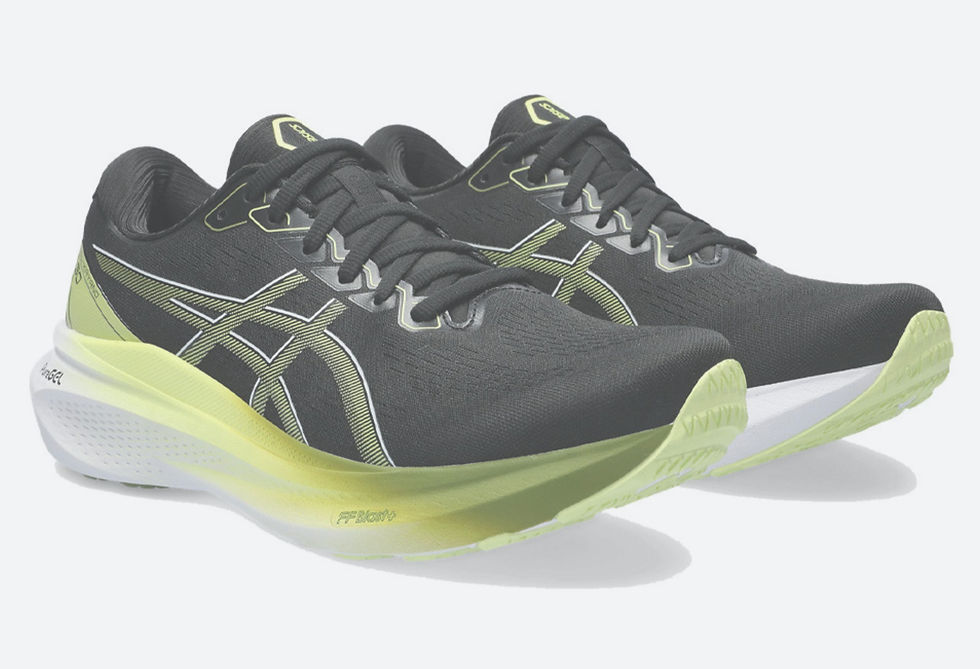
One of ASICS' biggest advances in recent years has been the introduction of FF BLAST™ PLUS cushioning. This lightweight foam provides a softer, more energetic ride than previous materials while helping reduce the overall weight of the shoe. It now features across much of the road running range, including the Gel-Nimbus and Gel-Cumulus.
FF BLAST™ TURBO
Designed specifically for racing, FF BLAST™ TURBO is ASICS' premium performance foam.
It's significantly lighter and more responsive than the company's everyday cushioning and is used in the METASPEED racing collection, where maximum energy return is the priority.
4D Guidance System™
Traditional stability shoes often relied on firm sections of foam to control foot movement.
ASICS has moved towards a more adaptive approach with its 4D Guidance System™, which works alongside the natural movement of the foot to provide support when it's needed without making the shoe feel overly rigid. This technology is now found in several of the brand's leading stability models.
The Most Popular ASICS Running Shoes
ASICS Gel-Nimbus
The Gel-Nimbus has long been one of ASICS' flagship neutral running shoes. Designed for maximum comfort, it combines premium cushioning with a smooth ride, making it particularly popular for easy runs, long-distance training and marathon preparation. It's an excellent choice for runners who prioritise comfort over outright speed.
ASICS Gel-Kayano
Few stability shoes have earned the reputation of the Gel-Kayano. Now in its thirtieth generation, it continues to provide reliable support while becoming lighter and more comfortable with each update. It's particularly well suited to runners who benefit from additional stability during longer runs without wanting the shoe to feel overly controlling.
ASICS Gel-Cumulus
The Gel-Cumulus sits just below the Nimbus within the ASICS range. Offering a balanced combination of cushioning and responsiveness, it's designed as a versatile daily trainer suitable for everything from shorter weekday runs to longer weekend sessions.
ASICS GT-2000
The GT-2000 has become one of the brand's most popular support shoes. Providing moderate stability alongside comfortable cushioning, it's often chosen by runners who want extra guidance without the premium price tag of the Kayano.
ASICS METASPEED Sky Paris
The METASPEED series represents ASICS' fastest road racing shoes. Featuring FF BLAST™ TURBO cushioning and a full-length carbon plate, the METASPEED Sky Paris is designed for runners targeting personal bests over distances ranging from 5K to the marathon. It has quickly established itself as one of the leading carbon-plated racing shoes available.
ASICS Gel-Trabuco
The Gel-Trabuco has been a favourite among trail runners for many years. Designed to provide grip, protection and confidence across varied terrain, it offers a dependable option for everything from forest trails to mountain adventures. Its combination of cushioning and stability makes it particularly popular for longer off-road runs.
Who Are ASICS Shoes Best Suited To?
One of ASICS' greatest strengths is the breadth of its range. Whether you're training for your first parkrun, preparing for a marathon or racing at an elite level, there's likely to be an ASICS shoe designed for your needs. The company offers neutral trainers, stability shoes, lightweight performance models and trail running shoes, allowing runners to remain within the same brand as their training evolves.
ASICS is particularly well known for producing durable daily trainers that balance comfort, support and longevity. Many runners also appreciate the consistency between generations, making it easier to replace a favourite model when it eventually reaches the end of its life.
Are ASICS Running Shoes Good Value?
ASICS shoes are positioned firmly within the premium running shoe market, but they've earned a reputation for quality and durability. Although flagship models such as the Gel-Nimbus and Gel-Kayano command premium prices, they often provide many months of comfortable training when used appropriately. The company also offers more affordable alternatives, including the Gel-Cumulus and GT-1000, giving runners a wide choice across different budgets.
As with any running shoe, the best option is the one that fits your feet, matches your running style and feels comfortable over the distances you plan to run. Visiting a specialist running retailer remains the best way to compare different models and receive expert advice before making a purchase.
Final Thoughts
ASICS has remained one of the world's leading running shoe manufacturers by staying true to its philosophy of combining science, innovation and comfort. While the technology has evolved dramatically over the years, the brand's focus has remained remarkably consistent: helping runners of every ability enjoy their sport through well-designed, dependable footwear.
Whether you're looking for the luxurious cushioning of the Gel-Nimbus, the trusted support of the Gel-Kayano, the versatility of the Gel-Cumulus or the race-day performance of the METASPEED series, ASICS offers one of the most comprehensive running shoe ranges available today. For runners seeking comfort, durability and proven performance, it's a brand that continues to set the standard


Comments