.png)

Amsterdam Marathon 2026: Everything You Need To Know
- 16 hours ago
- 11 min read
Looking for a fast autumn marathon in one of Europe's most distinctive cities? The TCS Amsterdam Marathon should certainly be on your list. With a start and finish at the historic Olympic Stadium, a famously flat course and sections through Vondelpark, beneath the Rijksmuseum and alongside the Amstel River, it combines serious racing credentials with an excellent city break.
The marathon has grown enormously in recent years and is now the largest in the Netherlands and one of the biggest in Europe. In 2026, 32,000 runners will take on the full marathon, with more than 60,000 participants across the different events during the weekend. If you're thinking about running the Amsterdam Marathon 2026, here's everything you need to know.

Amsterdam
Amsterdam is the capital of the Netherlands and one of Europe's most recognisable city break destinations. Its network of canals, narrow streets, historic houses, museums and parks makes it particularly well suited to a marathon weekend where you want plenty to see and do before or after the race.
The city's 17th century canal ring inside the Singelgracht has been a UNESCO World Heritage Site since 2010. Exploring the canals on foot or by boat is one of the easiest ways to experience Amsterdam, while cycling is another obvious option in a city where bicycles are an integral part of everyday life.
Amsterdam also has an extraordinary concentration of museums and cultural attractions. The Rijksmuseum is home to works by Rembrandt, Vermeer and many other Dutch masters, while the Van Gogh Museum contains the world's largest collection of works by Vincent van Gogh. Both are close to Museumplein and within relatively easy reach of the marathon's Olympic Stadium start and finish.
The Anne Frank House is another of Amsterdam's most visited attractions, but this is somewhere you need to plan ahead for because tickets are in extremely high demand. You can also visit the Royal Palace Amsterdam, explore the Heineken Experience or simply spend time wandering through the different neighbourhoods and alongside the canals.
If you want some open space away from the busiest parts of the city, Vondelpark is one of the obvious places to visit. Marathon runners will become particularly familiar with it because the park also plays an important part in the race route. Just remember that Amsterdam is an incredibly easy city in which to spend hours walking, so save some of the serious sightseeing until after you've collected your medal.
The Amsterdam Marathon
Marathon running in Amsterdam has a long history, with the city's most famous early race taking place during the 1928 Olympic Games. The Olympic Stadium built for those Games remains one of the defining features of the modern marathon and provides an unusual connection between the race and Amsterdam's Olympic past.
The modern Amsterdam Marathon began in 1975 as part of celebrations marking the city's 700th anniversary. Around 300 runners took part in that first edition, a remarkable contrast with the tens of thousands who now travel to Amsterdam for the event.
The marathon celebrated its 50th anniversary in 2025 and has developed into one of Europe's major international road races. It holds World Athletics Platinum Label status and has established a strong reputation for fast times, with elite athletes and recreational runners attracted by its predominantly flat course.
The wider event has grown considerably as well. The marathon is joined by a half marathon, 7.5K and shorter events across the weekend, turning it into one of the biggest running weekends in the Netherlands.
When Is The Amsterdam Marathon 2026?
The 2026 TCS Amsterdam Marathon takes place on Sunday 18 October, with the marathon starting from 9.00am. The Mizuno Half Marathon follows later in the day, while the 7.5K, Kids Runs and Heroes Run take place on Saturday 17 October.
October can provide very good marathon running conditions, but don't assume the weather will necessarily be perfect. Amsterdam can be cool at this time of year, but rain and particularly wind can make a significant difference, especially on the more exposed sections of the course alongside the Amstel River.
Check the forecast carefully during race week rather than planning your clothing and pacing several days in advance. Conditions can change quickly and what feels comfortable around the Olympic Stadium may be quite different when you're running beside the river.
How Many Runners Take Part?
The Amsterdam Marathon has grown dramatically. For 2026, there were 32,000 places available in the marathon itself, making this a major European city marathon.
The marathon field is split between two start areas, with 16,000 runners starting inside the Olympic Stadium and another 16,000 starting from Stadionweg immediately outside. All marathon runners eventually get the stadium experience because everyone finishes on the track inside the Olympic Stadium.
There are also 15,000 places in the Mizuno Half Marathon and another 15,000 in the 7.5K. Across the entire weekend, more than 60,000 participants are expected, so don't underestimate the scale of the event when making plans for accommodation, travel and race weekend.
The Amsterdam Marathon Course
Amsterdam has developed a reputation as a fast marathon destination, with a predominantly flat course that combines parks, city streets, major landmarks and a long section alongside the Amstel River.
It isn't a marathon that spends the entire 26.2 miles weaving through Amsterdam's historic canal district. The organisers investigated taking the route further into the historic centre but confirmed in 2026 that the existing course will remain for the coming years.
That doesn't mean the course lacks variety. Vondelpark, the Rijksmuseum, the Amstel and Olympic Stadium all provide very different surroundings, while the flatter profile means runners chasing a PB can establish a consistent rhythm for much of the race.
The Olympic Stadium Start
One of the things that immediately makes Amsterdam different is its Olympic Stadium. Built for the 1928 Olympic Games, it gives the marathon a start and finish location with genuine sporting history. For 2026, the field is large enough that not everyone can start inside the stadium. Start Area A accommodates 16,000 marathon runners inside the Olympic Stadium, while another 16,000 begin from Start Area B on Stadionweg immediately outside. With so many runners beginning in a relatively concentrated area, expect the opening kilometres to be busy. Don't waste energy weaving between people simply because your first kilometre is slightly slower than planned, particularly when you still have almost an entire marathon ahead of you.
Through Vondelpark
Early in the marathon, runners head towards Vondelpark, Amsterdam's largest and best known city park. It provides a greener and noticeably different setting from the streets surrounding the Olympic Stadium. Vondelpark is popular throughout the year with runners, cyclists, walkers and visitors, but marathon day gives it a very different atmosphere. At this stage of the race you should still be running comfortably and resisting the temptation to get carried away by the occasion. The park also plays another important role later in the marathon. You'll return to Vondelpark close to the end of the race, when those same paths are likely to feel very different with more than 40 kilometres in your legs.
Past The Rijksmuseum
One of the most recognisable sections of the Amsterdam Marathon comes around the city's museum district. Runners pass through the Rijksmuseum passage, taking the race beneath one of the Netherlands' most famous cultural landmarks. The Rijksmuseum is home to masterpieces including Rembrandt's The Night Watch and works by Vermeer, making this one of those points on the course where it is worth looking beyond your GPS watch for a few moments. The surrounding Museumplein area is also home to the Van Gogh Museum and other major attractions. If you're staying in Amsterdam after the marathon, this is somewhere worth returning to when you have rather more time to appreciate it.
Along The Amstel River
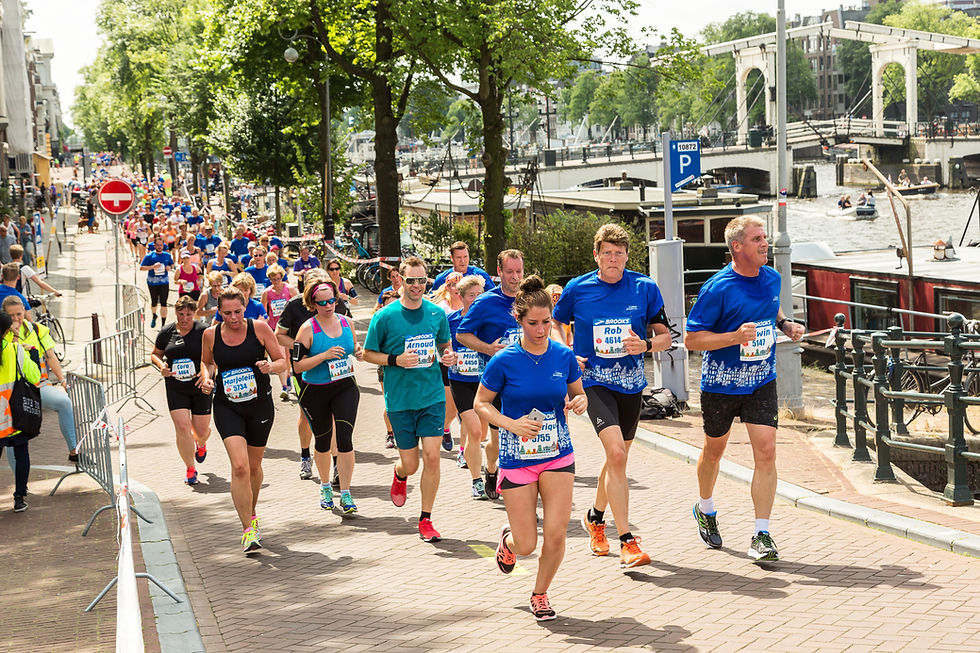
The long section beside the Amstel River is one of the defining parts of the Amsterdam Marathon and gives the race a very different character from its city sections. Runners head away from the more densely built areas of Amsterdam and into quieter surroundings alongside the water. Part of this section follows the route associated with the 1928 Olympic Marathon, adding another connection with the city's running history. The Amstel itself has played an important role in Amsterdam's development for centuries and the river provides some of the most scenic views on the course. This can also be one of the mentally tougher sections of the marathon. The surroundings are more open, crowd support can be less concentrated and wind can become more noticeable than it is between buildings in the city. Settle into your planned effort rather than becoming obsessed with individual kilometre splits if you encounter a headwind. You will eventually leave the river behind and begin working your way back towards the busier parts of Amsterdam.
Back Towards Amsterdam
After leaving the Amstel, the course begins taking runners back through Amsterdam and towards the final stages of the marathon. By now the race inevitably becomes less about sightseeing and more about managing tired legs, maintaining your fuelling and keeping your effort under control. This is where sensible early pacing starts to pay off. Amsterdam may be flat, but a flat marathon can still become extremely difficult if you've run the first 30 kilometres too quickly. As the surroundings become more urban again, the increased number of spectators can provide a welcome lift. Concentrate on maintaining your form and break the remaining distance into manageable sections rather than thinking about everything still to come.
The Final Run Through Vondelpark
Vondelpark returns close to the end of the marathon and provides one of the clearest reminders of how far you've travelled since the opening stages. What felt relaxed early in the race can feel considerably different when you're approaching 40 kilometres.
The good news is that reaching Vondelpark again means the Olympic Stadium isn't far away. The crowds also tend to build as runners get closer to the finish, giving you something to focus on during those difficult final kilometres. Use the atmosphere rather than worrying too much about maintaining a perfectly even pace. At this point the objective is simply to keep moving towards the stadium and the finish line.
The Olympic Stadium Finish
The finish inside the Olympic Stadium is arguably the defining moment of the Amsterdam Marathon. After 42 kilometres around the city and alongside the Amstel, runners enter the stadium and complete the final part of the race on the track. A stadium finish always creates a sense of occasion, but Amsterdam's connection with the 1928 Olympic Games makes this one particularly appropriate. The grandstands, other runners and spectators provide an impressive backdrop as you approach the line.
Take the opportunity to enjoy those final few hundred metres. Whether you've chased a PB, completed your first marathon or simply survived a difficult day, finishing inside the Olympic Stadium is one of the experiences that makes Amsterdam memorable.
Is The Amsterdam Marathon Fast?
Amsterdam has genuine PB potential and is widely regarded as one of Europe's faster major marathons. There is relatively little significant climbing and long sections allow runners to settle into a consistent rhythm.
That doesn't automatically make it an easy marathon. The exposed Amstel section can be affected by wind and the sheer size of the field means the opening stages may be congested, particularly if you start further back.
Your training, pacing, fuelling and race day weather will ultimately have a much greater impact on your finishing time than relatively small differences between flat marathon courses. If conditions are favourable and you've prepared properly, however, Amsterdam is certainly a race where a PB is possible.
Is There A Race Expo?
Runners need to collect their race number before the event at the International Marathon Expo, and there is an important change for 2026. The Expo is moving to RAI Amsterdam, providing considerably more space for runners, exhibitors and sponsors.
The Expo opens on Thursday 15 October and continues through Friday and Saturday. Marathon runners therefore need to make sure their travel plans give them enough time to collect their race number before it closes on Saturday.
As well as race number collection, you can expect running brands, event merchandise and other exhibitors. Don't spend hours walking around simply because you've arrived early, though, particularly if you're racing the marathon the following morning.
Aid Stations
There are regular refreshment stations around the marathon course, providing runners with fluids and additional race nutrition. The exact products and locations should always be checked against the final runner information because arrangements can change between editions.
You should still arrive with your own marathon fuelling plan rather than simply eating or drinking whatever appears in front of you. Practise your nutrition during long training runs so you know when you intend to take carbohydrate, how much fluid generally works for you and what your stomach can tolerate.
If you're planning to rely heavily on products supplied by the organisers, check exactly what will be available in 2026 and ideally try those products during training. Race morning isn't the time to discover that a particular gel or sports drink doesn't agree with you.
What Is The Crowd Support Like?
Amsterdam attracts runners from around the world and there is plenty of support around many parts of the course, particularly close to the Olympic Stadium, Vondelpark and the busier city sections.
You shouldn't expect continuous crowds for all 26.2 miles, however. The sections alongside the Amstel can feel considerably quieter and more exposed, which is something to be aware of if you rely heavily on spectator support for motivation.
The contrast actually gives the course some of its character. There are sections where you can concentrate on your running and others where the crowds build again and help pull you towards the finish.
The Amsterdam Half Marathon
The Mizuno Half Marathon is a major event in its own right and has capacity for 15,000 runners in 2026. It takes place on the Sunday afternoon, after the marathon has already been underway for several hours.
The half marathon starts at 1.20pm and has a three-hour time limit. Most importantly, half marathon runners also finish inside the Olympic Stadium, giving them the same memorable finish location as the marathon runners.
Having the half marathon later in the day helps keep the atmosphere around the Olympic Stadium going throughout Sunday afternoon. It also makes Amsterdam Marathon weekend an option for groups where not everyone wants to tackle the full 26.2 miles.
What Makes The Amsterdam Marathon Special?
The Olympic Stadium is the feature that really separates Amsterdam from many other European marathons. Starting in or immediately beside a stadium that hosted the 1928 Olympic Games and then returning to finish on its track gives the race a strong identity.
The course also manages to show several very different sides of Amsterdam. Vondelpark, the Rijksmuseum and the Amstel River provide contrasting surroundings, while the predominantly flat profile gives runners a genuine opportunity to run quickly if conditions are favourable.
Amsterdam itself is another major part of the attraction. It's easy to turn the marathon into a longer city break, with the canals, museums and different neighbourhoods giving you far more to explore than you could realistically fit into a race weekend.
Can You Run The Amsterdam Marathon For Charity?
The TCS Amsterdam Marathon supports the Dutch Cancer Society, KWF, with runners able to make a voluntary donation during registration. Money raised supports cancer research at Amsterdam UMC Cancer Center Amsterdam.
There is also a Run Against Cancer programme. For 2026, runners who raise at least €750 can receive a free race entry and a Run Against Cancer running shirt, providing another way to combine the event with fundraising. Lots of UK charities also have charity entries available.
There is nothing stopping you using your own Amsterdam Marathon place to raise money for another charity in the UK or elsewhere. An overseas marathon can provide a strong fundraising story because you can take supporters through your training, journey to Amsterdam and the marathon itself rather than simply sharing a fundraising link.
How To Get A Place In The Amsterdam Marathon 2026
Demand has increased significantly in recent years and the 50th anniversary edition sold out in record time.
International runners may also find travel packages through tour operators, but always check exactly what is included before booking. In particular, don't assume a hotel or travel package automatically includes a guaranteed marathon entry unless this is specifically stated. Charity entries are still available.
Our Verdict
The Amsterdam Marathon combines many of the things runners look for in a major European race. It has a predominantly flat course, a huge international field, excellent running credentials and one of the most distinctive start and finish locations of any marathon in Europe.
For us, the Olympic Stadium is what really makes the event stand out. Its connection with the 1928 Olympic Games gives the marathon a sense of history, while finishing on the track provides a memorable final few hundred metres after 26.2 miles.
The course itself is more varied than you might expect. You get Vondelpark, the Rijksmuseum and some recognisably Amsterdam surroundings, but also the long, quieter stretch beside the Amstel. Don't enter expecting the entire marathon to weave between canals and historic buildings in the city centre because that isn't what this course provides.
Amsterdam also works extremely well as a marathon weekend. It is easy to reach from the UK, public transport makes getting around relatively straightforward and there is an enormous amount to see if you stay for a few days after the race.
If you're looking for a fast European autumn marathon with PB potential, a large international field and a finish you'll remember long after the race is over, the Amsterdam Marathon 2026 deserves to be high on your list.


Comments