.png)

Fitbit Running Watches Explained: History, Features And The Best Models
Updated: Jul 31
There was a time when Fitbit was almost synonymous with fitness tracking. Millions of people wore a Fitbit to count their daily steps, monitor their sleep and encourage themselves to be more active. Long before Apple, Garmin and Samsung entered the wearable market in a serious way, Fitbit had become the brand that introduced everyday consumers to the idea of tracking their health from their wrist.
The wearable market has changed dramatically since those early days. Smartwatches have become more powerful, running watches have become increasingly sophisticated and health monitoring has evolved far beyond simply counting steps. Google's acquisition of Fitbit has also transformed the company, with the brand now sitting at the heart of Google's wider health strategy rather than competing solely as a fitness tracker manufacturer.
In this guide we look at the current Fitbit range, explain how Google has changed the platform, review the running features and help you decide whether a Fitbit is still the right watch for your next race.

The Story Of Fitbit
Fitbit was founded in 2007 with a simple ambition of helping people become more active. The company's first products were basic activity trackers that recorded steps, estimated calories burned and encouraged users to move more throughout the day.
The idea proved hugely successful. Fitbit quickly became one of the world's biggest wearable technology companies and played a major role in making fitness tracking mainstream. For many people, their first experience of monitoring exercise or sleep came through a Fitbit clipped to a waistband or worn around the wrist.
As technology improved, Fitbit expanded beyond simple activity trackers into smartwatches with GPS, heart rate monitoring and dedicated sports modes. Running became a much more important part of the platform, allowing users to record pace, distance, routes and heart rate without needing a separate device.
Competition also intensified during this period. Garmin continued to dominate the dedicated running watch market, Apple developed the Apple Watch into a powerful fitness device and brands such as Coros, Polar and Suunto introduced increasingly capable sports watches. Fitbit responded by strengthening its health features rather than trying to match every advanced running metric offered by its competitors.
Google's Acquisition Of Fitbit
Google completed its acquisition of Fitbit in 2021, marking the beginning of a new chapter for the brand. Rather than disappearing into Google, Fitbit became the foundation of Google's long term health and wearable strategy.
Today, Fitbit technology powers much of the health experience across Google's own devices. Pixel Watch models use Fitbit's activity tracking, sleep analysis, heart rate monitoring and workout platform, meaning Fitbit now reaches far beyond watches carrying its own name.
This has changed how Fitbit develops new products. The focus is no longer solely on creating hardware. Instead, Fitbit has merged into an integrated health platform that combines wearable devices, cloud services, health insights and AI driven analysis into one ecosystem.
Google Health: The Biggest Change To Fitbit
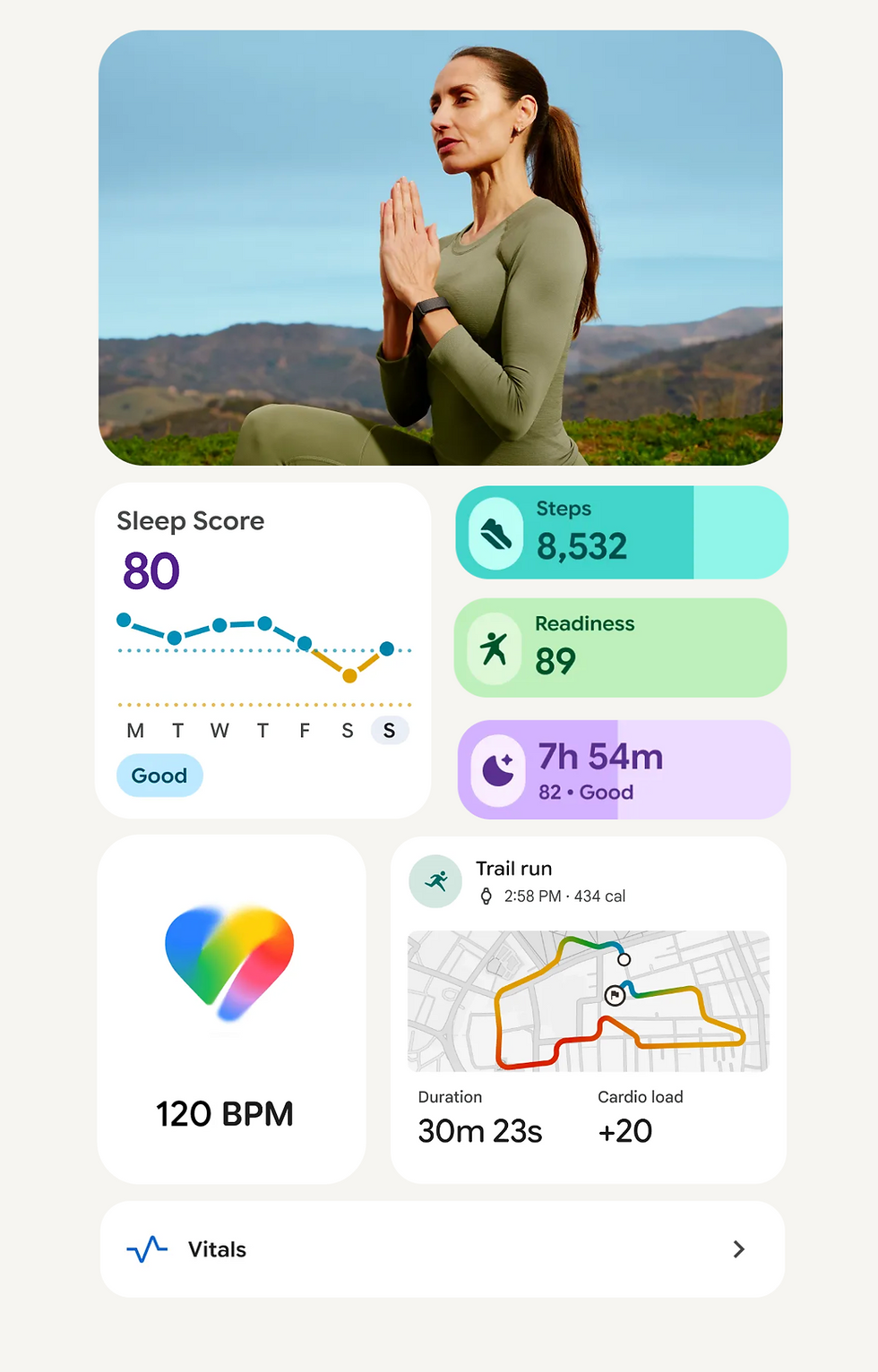
The biggest development for Fitbit users came in 2026 when Google officially replaced the Fitbit app with Google Health. Rather than simply changing the name, Google created a much broader health platform that brings together fitness tracking, sleep monitoring, wellbeing insights and AI-powered coaching within a single app.
Every new Fitbit and Pixel Watch now works with Google Health, with users signing in using their Google Account instead of the old Fitbit account. Fitbit Premium has also become Google Health Premium, adding personalised insights and AI-powered coaching through Google Health Coach, which is powered by Gemini.
For runners, this marks a significant change. Fitbit is no longer simply a manufacturer of fitness trackers and smartwatches. It has become the wearable arm of Google's wider health ecosystem, combining running data with sleep, recovery, heart rate and long-term health insights. As Google's AI continues to develop, Google Health is expected to deliver increasingly personalised recommendations that help runners improve both their training and their overall wellbeing.
The Current Fitbit Range
Fitbit's product range is smaller than it once was, making it easier to choose the right device. Rather than producing numerous overlapping models, the company now focuses on three core products that appeal to different types of users.
Fitbit Charge 6
The Charge 6 is arguably the best Fitbit for most runners. Although it is officially classified as a fitness tracker rather than a smartwatch, it delivers nearly everything recreational runners need while remaining significantly smaller and lighter than many competing devices.
Built in GPS allows you to leave your phone at home while accurately recording pace, distance and routes. Continuous heart rate monitoring provides useful training information, while automatic exercise recognition means many activities are detected without needing to manually start a workout.
The slim design is one of the Charge 6's biggest strengths. Many runners dislike wearing large watches throughout the day or while sleeping, whereas the Charge 6 is comfortable enough to wear almost continuously. That matters because Fitbit's health insights become more useful when the device is collecting data around the clock rather than only during exercise.
Battery life is another major advantage. Most users can expect around a week of everyday use depending on GPS usage, making the Charge 6 considerably more convenient than many full smartwatches that require charging every day.
For runners preparing for 5Ks, 10Ks and even marathons, the Charge 6 offers an impressive balance of price, comfort and functionality. Unless you specifically want smartwatch features such as apps, voice assistants and larger displays, it remains the standout product in the Fitbit range.
Fitbit Versa 4
The Versa 4 is Fitbit's all round smartwatch and is aimed at users who want much more than simply tracking their runs. It combines health monitoring, smartphone notifications, workout tracking and everyday smartwatch functionality within a lightweight design that remains comfortable for all day wear.
From a running perspective, the Versa 4 provides accurate GPS tracking, pace, distance, heart rate monitoring and post run summaries that are easy to understand. Navigation through the interface is straightforward and the Amoled display is bright enough to remain readable during outdoor training sessions.
Where the Versa 4 stands out is its balance. It feels less like a dedicated sports watch and more like a smartwatch that encourages an active lifestyle. Users can monitor their workouts in the morning, receive calls and notifications during the day and continue tracking sleep overnight without changing devices.
Battery life comfortably exceeds many traditional smartwatches, with several days of normal use possible between charges. That makes it particularly appealing to runners who dislike having to constantly monitor battery percentages before every training session.
Fitbit Sense 2
The Sense 2 sits at the top of Fitbit's own range and places health monitoring at the centre of the experience. While its running features are very similar to those found on the Versa 4, it includes additional sensors designed to provide a broader understanding of your overall wellbeing.
Stress tracking, ECG capability in supported regions, skin temperature trends and more advanced health monitoring help create a more complete picture of how your body is responding to everyday life as well as training. Rather than focusing purely on improving running performance, the Sense 2 encourages users to think about recovery, sleep and long term health alongside exercise.
For runners balancing busy careers, family life and training, these additional insights can often prove more valuable than another page of advanced running statistics. Understanding whether poor sleep or increased stress is affecting recovery may ultimately have a greater impact on training consistency than analysing a few extra performance graphs.
The Sense 2 is therefore best viewed as a premium health smartwatch that also happens to be an excellent running companion. Those seeking specialist endurance training features may find it lacks some of the advanced analysis offered elsewhere, but users looking for one watch to manage every aspect of their health will appreciate its broader approach.
Which Fitbit Is Best For Runners?
For most runners, the Charge 6 remains the easiest recommendation. It offers virtually every running feature that recreational athletes require while remaining lightweight, comfortable and competitively priced. Unless smartwatch functionality is particularly important, it represents the strongest value within the current Fitbit range.
The Versa 4 is ideal for runners wanting a balance between fitness tracking and everyday smartwatch features. It feels more versatile than the Charge 6 without becoming unnecessarily complicated, making it an excellent choice for users who spend as much time wearing their watch in the office as they do out on the road.
The Sense 2 is aimed at people who place overall health at the centre of their fitness journey. Its additional wellness features make it particularly attractive for runners who are equally interested in improving sleep, managing stress and understanding long term health trends alongside their training.
Running Features And Google Health
Although Fitbit has increasingly shifted towards health and wellness, running remains one of its core activities. Every current Fitbit device can track outdoor runs using GPS, recording pace, distance, elapsed time and heart rate before automatically syncing your workout to Google Health.
The running experience remains intentionally simple. Rather than presenting numerous data screens filled with advanced performance metrics, Fitbit focuses on the information that most runners actually use during a workout. Pace, distance, time and heart rate are easy to view on your wrist, while Google Health provides clear post-run summaries alongside wider health information such as sleep, recovery and overall activity trends.
One of the biggest changes is what happens after your run. Instead of simply storing your workout history, Google Health places each run into the context of your overall wellbeing. Your training sessions can be viewed alongside sleep quality, recovery, cardio load, heart rate trends and, for Google Health Premium users, personalised insights from Google Health Coach. This gives runners a broader understanding of how training fits into their overall health rather than treating every run as an isolated activity.
For many runners this simplicity is actually one of Fitbit's biggest strengths. Someone training for their first 10K, half marathon or marathon is unlikely to need dozens of technical graphs after every session. They simply want to know how far they ran, how fast they were, whether they are becoming fitter and how their training is affecting their overall health. Fitbit and Google Health present that information in a straightforward and easy-to-understand way.
More experienced runners may eventually want additional performance data such as advanced training load analysis, running dynamics, race predictions and detailed physiological metrics. These remain areas where Garmin, Coros and Polar have the advantage. Fitbit deliberately takes a different approach by combining straightforward run tracking with Google's wider health ecosystem, making it a stronger choice for runners who value fitness, recovery and everyday wellbeing as much as pure performance analysis.
GPS Accuracy
GPS accuracy has improved significantly over recent generations and current Fitbit devices perform well during everyday road running. In open environments, recorded distances are generally consistent with other leading wearable brands, while pace data is accurate enough for the vast majority of training sessions.
Like every wrist based GPS device, accuracy can be affected by tall buildings, tunnels or dense tree cover. These environments interrupt satellite signals and occasionally cause minor variations in recorded pace or distance. In normal conditions, however, Fitbit provides reliable tracking that will satisfy most recreational runners.
For runners training using mile or kilometre splits, the recorded data is more than adequate for monitoring progress over time. Those chasing every second in elite level competition may prefer devices that support additional satellite systems and more detailed positioning technology, but for everyday runners the differences are unlikely to have any meaningful impact.
Heart Rate Monitoring
Heart rate monitoring has always been one of Fitbit's strongest features. The optical sensors used across the current range perform particularly well during steady paced runs where heart rate changes gradually throughout the session.
Short, high intensity intervals can still produce a slight delay compared with a chest strap, but this is a characteristic shared by almost every optical wrist sensor rather than being unique to Fitbit. For easy runs, long runs and tempo sessions, the readings are consistently reliable enough for most runners to train confidently using heart rate zones.
The real advantage comes from continuous monitoring throughout the day. Rather than simply measuring heart rate during exercise, Fitbit builds a much broader picture by combining resting heart rate, overnight trends and recovery patterns. This provides context that many runners find just as valuable as their workout data.
Sleep Tracking
Sleep tracking remains one of the areas where Fitbit continues to lead the market. Every morning users receive a detailed breakdown of their sleep, including duration, sleep stages and an overall Sleep Score that makes it easy to recognise patterns over time.
For runners, good sleep is one of the most important aspects of recovery. Consistently poor sleep affects training quality, recovery, motivation and injury risk, yet it is often overlooked in favour of analysing pace or mileage. Fitbit encourages runners to pay attention to this often neglected area by presenting the information in a clear and accessible format.
Rather than burying the data inside complicated charts, Fitbit explains how well you have recovered and whether your sleep is improving. That makes the information genuinely useful rather than simply interesting.
Recovery And Health Features
This is where Fitbit has deliberately separated itself from many competitors. Instead of concentrating almost exclusively on athletic performance, the platform looks at overall wellbeing and how different aspects of your health interact with one another.
Features such as Daily Readiness Score for Premium subscribers combine recent exercise, sleep quality and recovery data to suggest whether your body is ready for another hard workout or whether a lighter session may be more appropriate. The emphasis is on helping users build sustainable habits rather than pushing harder every day.
Current Fitbit devices also include features such as resting heart rate trends, breathing rate, blood oxygen monitoring during sleep on supported devices, stress management tools and skin temperature trends. The Sense 2 adds ECG capability in supported countries, allowing eligible users to record an electrocardiogram directly from their wrist.
These are not features designed specifically for runners, but they help create a more complete picture of overall health. For many recreational athletes that broader perspective is ultimately more valuable than another advanced running metric.
Battery Life
Battery life continues to be one of Fitbit's biggest advantages. The Charge 6 can typically last around seven days between charges with normal use, while the Versa 4 and Sense 2 also comfortably outperform many traditional smartwatches during everyday use.
GPS activity naturally reduces battery life, but most runners will still have more than enough capacity for regular training throughout the week. Only those tackling very long endurance events are likely to encounter limitations compared with specialist endurance watches.
The ability to wear a Fitbit continuously also improves the quality of its health data. Because charging is needed less frequently, the watches spend more time collecting sleep, recovery and activity information, making the overall health insights more accurate.
Are Fitbit Watches Still Relevant For Runners?
Absolutely, although perhaps not for exactly the same audience they once targeted. Fitbit has evolved from being primarily a fitness tracker into a comprehensive health platform that includes excellent running features alongside sleep tracking, recovery monitoring and overall wellness.
If your goal is completing Couch to 5K, improving your fitness, training for local races or simply becoming healthier, Fitbit remains one of the best choices available. The watches are comfortable, reliable and backed by software that makes understanding your progress refreshingly straightforward.
If you are training for competitive marathons, ultras or aiming for significant personal bests, you may eventually outgrow Fitbit's running features. That is not because the watches are poor at recording runs, but because specialist sports watches offer a greater depth of performance analysis for athletes who genuinely need it.
Final Thoughts On Fitbit Running Watches
Fitbit no longer dominates the wearable market in the way it once did, but it has successfully reinvented itself. Instead of trying to compete head to head with every dedicated running watch, it has become part of one of the world's strongest health platforms, combining exercise tracking with sleep analysis, recovery insights and long term wellness monitoring.
The Charge 6 remains the standout choice for most runners thanks to its lightweight design, accurate GPS and excellent value for money. The Versa 4 is an outstanding all round smartwatch for people who want one device for both everyday life and training, while the Sense 2 is the premium option for users who place health monitoring at the centre of their fitness journey.
For recreational runners, Fitbit is still a very relevant choice in 2026. It may no longer be the first name that comes to mind when discussing marathon training, but for millions of runners who simply want to stay healthy, active and motivated, it continues to offer one of the most complete and enjoyable wearable experiences available.


Comments