.png)

Mizuno Running Shoes Explained: History, Technology And Models
Mizuno has been producing sporting equipment for more than a century and has developed one of the most recognisable approaches to running shoe design. Its current range stretches from dependable everyday road shoes to highly cushioned models, stability shoes, faster training footwear, specialist racing shoes and dedicated trail options.
The Wave Rider remains at the centre of the road range, while the Wave Sky provides greater cushioning and the Wave Inspire and Wave Horizon offer different approaches to additional stability. Move towards Mizuno's newer performance footwear and the Neo family becomes increasingly important, before the Wave Rebellion range takes the technology into specialist racing.
This guide explains what Mizuno running shoes are known for, how technologies including Mizuno Wave, Enerzy, Enerzy NXT and Smooth Speed Assist work and some of the current models worth knowing about. It is a starting point rather than a complete catalogue, with different generations and regional variations often available at the same time.
Who Is Mizuno?
Mizuno was founded in Osaka, Japan, in 1906 by brothers Rihachi and Rizo Mizuno. The original Mizuno Brothers business sold western goods including baseball equipment before gradually becoming increasingly involved in manufacturing sporting products.
The company's involvement in athletics stretches back almost a century. Mizuno began manufacturing track and field shoes in 1928, establishing a connection with running long before the development of the modern cushioned road running shoe.
One of the defining developments in Mizuno's more recent running history was Mizuno Wave. The technology was designed to combine cushioning with stability through a wave shaped structure incorporated into the shoe.
The original Wave Rider made its global debut in 1997 and subsequently became one of Mizuno's longest established running shoe families. Later developments including Enerzy cushioning and the Neo and Wave Rebellion ranges have considerably broadened the company's approach beyond its traditional Wave construction.
What Makes Mizuno Running Shoes Different?
Mizuno has historically placed considerable emphasis on combining cushioning with stability rather than simply making a running shoe as soft as possible. Mizuno Wave became central to that approach and remains one of the technologies most closely associated with the brand.
The modern range is considerably broader, with different forms of Wave technology sitting alongside newer cushioning materials and more aggressive geometries. This allows Mizuno to produce shoes with noticeably different characteristics rather than applying one formula across its entire collection.
A Wave Rider 30 is therefore very different from a Neo Vista 3 or Wave Rebellion Pro 3. The Rider is designed primarily around dependable everyday mileage, while the Neo Vista moves towards highly cushioned performance training and the Rebellion Pro is a specialist racing shoe.
The range is easiest to understand by beginning with what you need the shoe to do. Everyday running, greater cushioning, additional stability, faster training, racing and trails all lead towards different parts of the Mizuno collection.
How Do Mizuno Running Shoes Fit?
Fit varies between Mizuno models and generations, particularly now that the range includes conventionally constructed Wave shoes alongside newer models using very different uppers and geometries. Experience with one Mizuno should therefore not automatically determine which size you need in another.
A Wave Rider, Neo Vista and Wave Rebellion Pro are designed for different purposes and can feel noticeably different even when the labelled size is identical. Racing footwear in particular may provide a more specialised fit than a conventional everyday running shoe.
Mizuno offers different width options in parts of its range, although availability varies between models, men's and women's shoes and individual markets. Runners needing additional width should check the specific model rather than assuming every Mizuno is available in the same options.
Your toes should have enough room to move while the heel and midfoot remain comfortably secure. Feet can expand during longer runs, making it particularly important to judge fit with the distances and type of running you actually intend to complete.
What About Heel Drop?
There is no single heel drop across Mizuno running shoes. Different models use different offsets according to their intended purpose, and those figures can change when a shoe is redesigned.
Mizuno has historically produced several road shoes with relatively conventional heel to toe drops, but the modern collection is much broader. High stack Neo models and the distinctive geometry of the Wave Rebellion range can provide very different experiences from the company's established everyday shoes.
The Wave Rider 30 demonstrates why checking the current specification matters. Mizuno has moved the shoe to an 8mm drop as part of a major redesign, alongside a taller midsole and the introduction of a full length Wave Plate.
Heel drop should not be considered in isolation. Stack height, cushioning, stiffness, rocker geometry, plate construction and the overall shape of the shoe all influence how it feels while running.
What Is Mizuno Running Shoe Cushioning Like?
Mizuno's cushioning has changed considerably as the company has expanded beyond the firmer ride historically associated with some of its running shoes. The modern collection contains everything from conventional everyday cushioning to softer and more responsive materials used in high stack training and racing footwear.
Enerzy became an important part of that development, while Enerzy NXT has subsequently extended Mizuno's approach to softer and more responsive cushioning. Different versions and applications of these materials now appear throughout the range.
The result is a collection containing substantially different experiences. A Wave Rider combines modern cushioning with the structure provided by a Wave Plate, while shoes within the Neo family use high stack constructions to create a different type of ride.
The name of the cushioning therefore provides only part of the story. The amount of foam, geometry, Wave construction, plate and upper all contribute to how the finished shoe behaves.
What Is Mizuno Wave?
Mizuno Wave is the technology most closely associated with the company's running shoes. It was developed around the challenge of providing cushioning and stability within the same construction.
The principle uses a wave shaped structure to help absorb and disperse forces during landing while also providing stability. Different implementations have developed over time, meaning Mizuno Wave should not be thought of as one identical component fitted to every shoe.
A traditional Wave Plate uses a physical plate within the midsole, while Foam Wave takes a different approach by using layers of cushioning arranged in a wave shaped geometry. Both apply the same broad concept in different ways.
The technology has therefore evolved considerably since the original Wave Rider appeared in 1997. Wave remains an important part of Mizuno's identity, but its role depends on the construction and purpose of the individual shoe.
What Is A Mizuno Wave Plate?
The Wave Plate is one of the best known applications of Mizuno Wave technology. A wave shaped plate is incorporated into the midsole to help distribute impact while contributing structure and stability.
Its design can vary considerably between different shoes and generations. The Wave Rider 30 is a particularly important example because it introduces a full length Wave Plate to the Rider family for the first time, forming part of a substantial redesign of Mizuno's principal everyday shoe.
That does not make the Wave Rider a carbon plated racing shoe. Its Wave Plate has a different purpose from the carbon reinforced plate used within Mizuno's specialist racing footwear.
The distinction matters because the word plate has become closely associated with modern super shoes. Plates can perform very different functions according to their material, shape, stiffness and position within a running shoe.
What Is Foam Wave?
Foam Wave applies Mizuno's Wave principle without relying on a traditional rigid Wave Plate. Different layers and densities of cushioning can be arranged in a wave shaped structure within the midsole itself.
This allows Mizuno to combine cushioning with inherent stability while producing a different experience from its traditional Wave Plate designs. The technology is used across both road and trail footwear, depending on what Mizuno wants an individual shoe to achieve.
The Wave Sky 9 uses Foam Wave alongside nitrogen infused Enerzy NXT cushioning, while the Wave Mujin 11 applies Foam Wave within a trail shoe designed to combine cushioning with stability on more demanding terrain.
As with any running shoe technology, the presence of Foam Wave does not tell you everything about how a shoe will feel. Cushioning materials, platform width, upper construction and overall geometry remain equally important.
What Is Mizuno Enerzy?
Mizuno Enerzy is a cushioning technology developed to combine softness with energy return. Its introduction represented an important development in the character of Mizuno's running shoes.
Earlier Mizuno models could sometimes feel relatively firm compared with softer alternatives from other brands. Enerzy allowed the company to place greater emphasis on cushioning and responsiveness while retaining the controlled transitions associated with much of its footwear.
Different forms and applications of Enerzy have subsequently appeared throughout the running range. The technology can work alongside Wave structures and other components rather than operating as a complete shoe system by itself.
Two Mizuno shoes containing Enerzy technology can therefore still feel substantially different. The amount of cushioning, geometry and other components surrounding the foam help determine the finished running experience.
What Is Mizuno Enerzy NXT?
Enerzy NXT is a newer generation of Mizuno cushioning and has become increasingly important across the company's running range. Different formulations and applications can be used according to the requirements of the individual shoe.
Nitrogen infused Enerzy NXT now appears in several important current models. The Wave Rider 30 uses it within its redesigned midsole, while the Wave Sky 9 uses the material as part of its highly cushioned construction and the Wave Inspire 22 incorporates it throughout its redesigned midsole.
The technology also plays an important role within Mizuno's newer performance footwear. Its use has helped the company develop softer and more responsive shoes without abandoning the stability and controlled transitions associated with many Mizuno models.
Enerzy NXT does not by itself define how a shoe will feel. Its behaviour depends on the formulation, amount of cushioning, geometry and complete construction surrounding it.
What Is Smooth Speed Assist?
Smooth Speed Assist is Mizuno's technology designed around faster running. Rather than being a cushioning material, it is an approach to shoe geometry intended to encourage a smooth transition through the stride at speed.
The technology has become particularly associated with the Wave Rebellion family. Mizuno combines the geometry with performance cushioning and carbon reinforced Wave technology to create a running experience that is substantially different from its everyday road shoes.
Smooth Speed Assist also appears within performance training footwear, demonstrating that the concept is not restricted solely to race day shoes. How aggressive it feels depends on the complete geometry and purpose of the individual model.
The resulting experience can be very different from a conventional running shoe, particularly within the Wave Rebellion family. Runners considering one of these models should use it during training before relying on it for an important race.
Does Mizuno Make Neutral Running Shoes?
Yes. A large part of Mizuno's road running collection consists of neutral shoes, with different models covering everything from everyday mileage to specialist performance footwear.
The Wave Rider 30 is one of the clearest examples and sits near the centre of the everyday range. The Wave Sky 9 provides a more cushioned neutral alternative, while the Neo Zen 2 and Neo Vista 3 offer a more modern high stack approach to training.
Move towards racing and the Wave Rebellion family becomes increasingly specialised. Neutral therefore describes the absence of a dedicated stability system rather than one particular type of Mizuno running shoe.
A neutral shoe can still feel inherently stable because of its platform, Wave technology, cushioning and geometry. Choosing between these models should begin with how you want the shoe to feel and the type of running you intend to do.
Does Mizuno Make Stability Running Shoes?
Yes. Mizuno has a long history of incorporating stability into its running shoes, although the way that support is created has developed alongside its cushioning and Wave technologies.
The Wave Inspire 22 is one of the principal stability shoes in the current range. Its redesigned midsole uses nitrogen infused Enerzy NXT, while the supportive Wave Plate is shaped to help control excessive inward movement and create a stable transition through the stride.
The Wave Horizon 9 provides a more substantial alternative. It combines a broad construction with Enerzy NXT, Enerzy cushioning, an asymmetrical Wave design and additional support on the inside of the shoe.
The distinction gives runners two different approaches to stability. The Inspire 22 is the more conventional everyday stability option, while the Horizon 9 moves further towards substantial cushioning and support.
Does Mizuno Make Carbon Plated Running Shoes?
Yes. Mizuno produces specialist plated racing footwear, although its approach looks noticeably different from many conventional carbon super shoes.
The Wave Rebellion Pro 3 is one of the clearest examples. It combines performance cushioning with a carbon reinforced Wave Plate and Smooth Speed Assist geometry in a shoe designed specifically around faster road racing.
The distinctive geometry makes the Rebellion Pro considerably more specialised than a conventional everyday running shoe. Its construction is designed around maintaining efficient transitions at speed rather than simply placing a carbon plate inside a familiar shoe shape.
Carbon technology should therefore be considered as part of the complete shoe rather than in isolation. Fit, comfort and whether the geometry works with your running style remain more important than choosing a shoe simply because it contains a carbon reinforced plate.
Does Mizuno Make Trail Running Shoes?
Yes. Mizuno produces trail running shoes covering different distances and types of terrain, giving runners several options beyond its better known road footwear.
The Neo Daichi 10 provides one of the more versatile routes into Mizuno's trail collection. Designed to balance cushioning, grip and protection across varied terrain, it is aimed at runners who want an adaptable trail shoe for everything from regular off road runs to longer adventures on more demanding surfaces.
The Wave Mujin 11 moves towards more demanding trails and places greater emphasis on cushioning, stability and protection. It uses Enerzy NXT, a full length Foam Wave construction and Vibram Megagrip.
The distinction gives trail runners two noticeably different options. The Daichi is a versatile choice for varied off road running, while the Mujin becomes more relevant as terrain and distance place greater emphasis on protection and support.
Which Mizuno Running Shoes Should You Consider?
Mizuno's range changes regularly and older generations often remain available alongside newer shoes. The models below represent some of the most important parts of the current collection rather than every Mizuno running shoe available.
The range is particularly broad because long established Wave families now sit alongside newer Neo footwear and specialist Wave Rebellion racing shoes. This gives runners considerably more choice than simply selecting between different levels of traditional Mizuno cushioning.
Mizuno Wave Rider 30
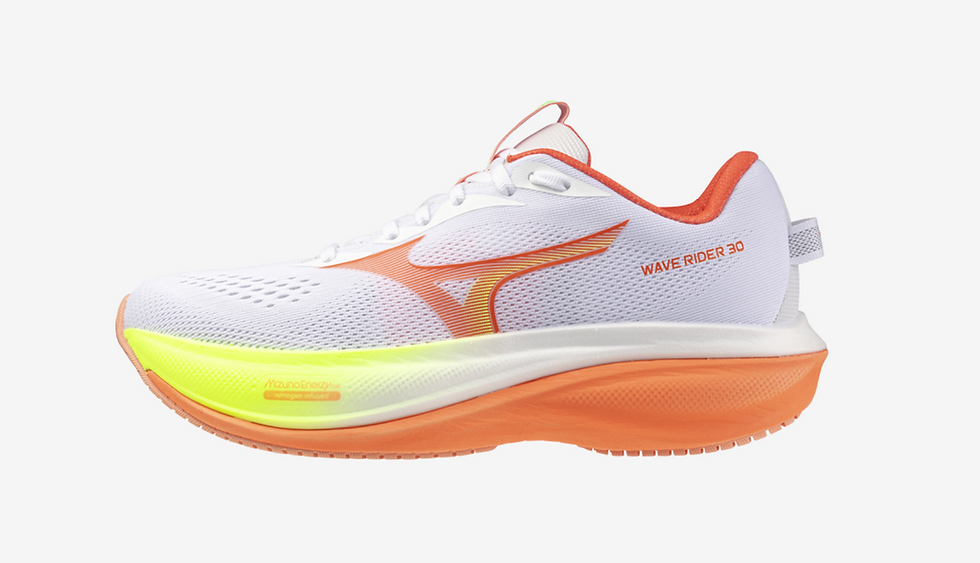
The Wave Rider 30 (pictured above) sits at the heart of Mizuno's everyday road running range and represents one of the biggest changes to the long established Rider family. It combines nitrogen infused Enerzy NXT cushioning with a full length Wave Plate, introduced to the Rider family for the first time. Mizuno has also changed the geometry substantially. The Wave Rider 30 uses an 8mm drop with a 42.5mm heel and 34.5mm forefoot stack, creating a taller and more modern construction than runners familiar with older Riders may expect. Its role nevertheless remains straightforward. The Rider is designed for everyday running, making it relevant to beginners as well as experienced runners wanting a dependable shoe for regular mileage. Move towards greater cushioning and the Wave Sky 9 becomes relevant, while runners wanting additional stability can investigate the Wave Inspire 22. The Neo family provides another direction for runners wanting a more performance focused high stack experience.
Mizuno Wave Sky 9
The Wave Sky 9 is Mizuno's highly cushioned neutral road shoe and provides a more substantial alternative to the Wave Rider. It uses nitrogen infused Enerzy NXT cushioning together with Foam Wave to combine a soft underfoot experience with enough structure for regular training. That makes the Wave Sky particularly relevant for easy runs, longer mileage and runners who enjoy having more cushioning beneath their feet. It is designed around comfort and smooth transitions rather than creating the lightest or most direct running experience. The distinction from the Wave Rider is relatively straightforward. The Rider provides a versatile everyday option, while the Sky moves further towards cushioning and protection for runners who prioritise comfort. The Wave Sky 9 also demonstrates how much Mizuno's traditional running shoe character has changed. Runners who still associate the brand primarily with firmer cushioning may find the modern Sky noticeably different from older Mizuno footwear.
Mizuno Wave Inspire 22
The Wave Inspire 22 is one of Mizuno's principal stability road shoes and provides the most obvious supportive alternative to the neutral Wave Rider. This generation has received a substantial redesign rather than simply making small changes to the previous Inspire.
The midsole now uses nitrogen infused Enerzy NXT throughout, while the drop has moved from 12mm in the Inspire 21 to 10mm. Mizuno combines the cushioning with a supportive Wave Plate designed to provide additional stability while allowing a smooth transition through the stride. Its role remains everyday running. The Inspire makes sense for runners wanting a regular training shoe with more guidance and support than a neutral model such as the Wave Rider. Runners wanting a more substantial stability shoe can move towards the Wave Horizon 9. The two models therefore provide different levels and styles of support rather than competing for exactly the same runner.
Mizuno Wave Horizon 9
The Wave Horizon 9 sits towards the more substantial end of Mizuno's stability collection and is designed around combining generous cushioning with a highly supportive platform.
Its midsole uses nitrogen infused Enerzy NXT in the upper layer alongside Enerzy cushioning below. An asymmetrical Wave design and additional support on the inside of the shoe contribute to the stable experience, while the broad construction provides a planted platform beneath the foot. This gives the Horizon a different role from the Wave Inspire 22. The Inspire is the more conventional everyday stability option, while the Horizon moves further towards cushioning and support. The Horizon makes most sense for easy mileage, longer steady running and runners who value a substantial and stable feeling beneath the foot. Those wanting something less substantial are more likely to begin with the Inspire.
Mizuno Neo Zen 2
The Neo Zen 2 is part of Mizuno's newer generation of high stack neutral running shoes and provides an alternative to the company's more traditional Wave families. It is designed to combine generous cushioning with a relatively lightweight and responsive running experience. Its role makes it particularly relevant to runners wanting modern cushioning without immediately moving into a specialist racing shoe. Regular mileage can sit alongside faster training, giving the Neo Zen broader versatility than Mizuno's most specialised performance models. The Neo Zen also demonstrates how much Mizuno's road collection has expanded. Runners are no longer choosing solely between different Wave models, with the Neo family offering a noticeably different approach to daily and performance running.
Move towards a more substantial performance training shoe and the Neo Vista 3 becomes relevant. Runners wanting a more conventional everyday experience can instead begin with the Wave Rider 30.
Mizuno Neo Vista 3
The Neo Vista 3 sits further towards performance training and combines substantial cushioning with geometry designed to create smooth transitions across a range of training speeds. It occupies the space between a conventional daily running shoe and Mizuno's more specialised racing footwear. Long runs and demanding marathon training are among its most obvious uses, particularly for runners wanting substantial cushioning without relying on specialist race shoes for every harder session. Its construction makes it particularly relevant to runners who enjoy the feel of modern high stack performance footwear.
Its position is therefore different from both the Wave Rider and Wave Rebellion Pro. The Rider provides the more conventional everyday experience, while the Neo Vista moves further towards faster and longer performance training. The Wave Rebellion range remains the next step for runners specifically looking for specialist race day footwear. That separation helps make the Neo Vista useful as part of a shoe rotation rather than simply treating it as another racing model.
Mizuno Wave Rebellion Pro 3
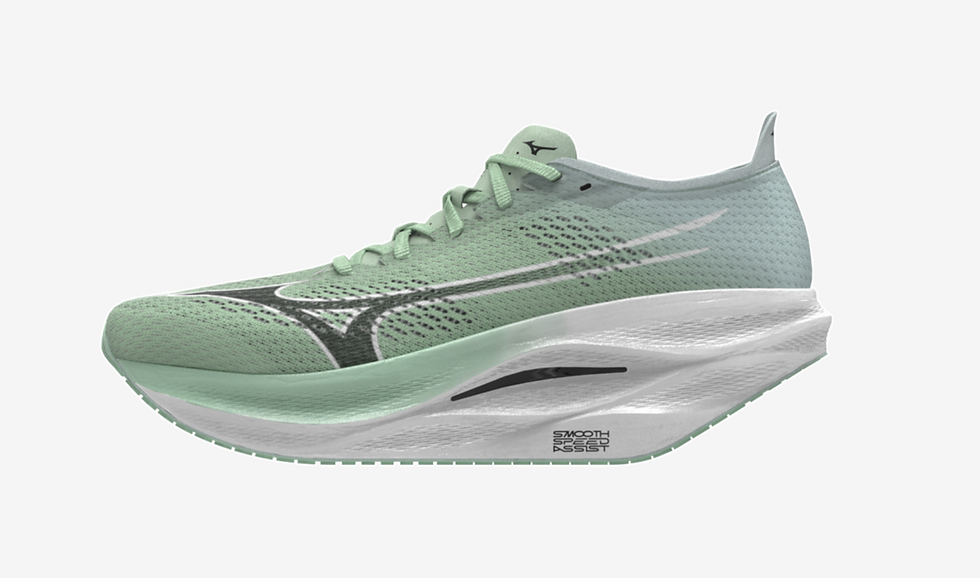
The Wave Rebellion Pro 3 (pictured below) sits at the specialist end of Mizuno's road running collection and is one of the most distinctive shoes the company produces. It combines performance cushioning with a carbon reinforced Wave Plate and Smooth Speed Assist geometry for faster road racing. Its dramatically shaped sole immediately separates it from conventional road running shoes. The geometry is intended to support efficient running at speed, making the shoe considerably more specialised than a Wave Rider or Neo model.
That specialist construction means the Wave Rebellion Pro will not suit every runner equally. Its unusual geometry can feel very different from a conventional road shoe and deserves proper testing during faster training before race day. Consider it if you specifically want Mizuno's specialist racing technology. Runners wanting performance footwear with greater versatility for repeated training are more likely to begin with the Neo family.
Mizuno Neo Daichi 10
The Mizuno Neo Daichi 10 is a versatile trail running shoe designed to handle a broad mixture of off road terrain. The change from Wave Daichi to Neo Daichi also reflects Mizuno's move towards a more modern construction for this part of its trail range.
The shoe is designed to combine cushioning, protection and grip without becoming an excessively heavy or specialised trail option. This makes it relevant for runners tackling everything from straightforward woodland paths to longer runs across more varied terrain.
Its position within the range makes the Neo Daichi 10 a useful option for runners wanting one trail shoe to cover a variety of conditions. The Neo name also brings it closer to Mizuno's newer generation of running footwear rather than simply continuing the established Wave Daichi formula. Runners moving towards longer distances or more demanding terrain can investigate the Wave Mujin 11. The two shoes cover different requirements, with the Neo Daichi 10 providing the more versatile option and the Mujin placing greater emphasis on cushioning, stability and protection.
Mizuno Wave Mujin 11
The Wave Mujin 11 moves towards more demanding trail running where cushioning, grip and stability become increasingly important. It uses Enerzy NXT in the upper part of the midsole and a full length Foam Wave construction to provide cushioning while retaining support. Vibram Megagrip provides traction on wet and uneven surfaces, while the upper incorporates a midfoot lacing structure intended to hold the foot securely. These features make the Mujin particularly relevant when terrain and distance place greater demands on the shoe. Its role is noticeably different from the more versatile Neo Daichi 10. Runners spending extended periods on technical trails may value the additional cushioning and support of the Mujin, while those running less demanding routes may prefer the Daichi.
Neither model is automatically better. Trail shoes should be chosen according to the terrain and distances you actually run rather than simply selecting the most substantial option available.
Are Mizuno Running Shoes Good For Beginners?
They can be. Mizuno produces several straightforward everyday shoes alongside its more specialised performance footwear, so there is no need for a new runner to begin with one of the brand's racing models.
The Wave Rider 30 is one of the clearest places to start because it is designed around versatile everyday mileage. The Wave Sky 9 provides an alternative for runners wanting additional cushioning, while the Wave Inspire 22 offers a route into the range for those who prefer more stability.
There is no reason for a beginner to start with a Wave Rebellion simply because it contains some of Mizuno's most specialised technology. A comfortable everyday shoe can cover the majority of early running while you discover what type of cushioning, fit and geometry you prefer.
Getting the fit right remains more important than choosing the Mizuno with the greatest amount of cushioning or most advanced performance technology. Comfort during the type of running you actually do should remain the priority.
Are Mizuno Running Shoes Sustainable?
Mizuno has increased its focus on environmental impact across footwear and its wider sporting goods business. Recycled materials and other environmental measures now appear within parts of the running range, although the exact construction varies considerably between individual models.
Sustainability claims should therefore be considered at individual product level. Different Mizuno shoes use different foams, plates, rubbers, textiles and manufacturing processes, so the environmental characteristics of one model should not automatically be applied to the entire range.
Durability is also relevant when considering the wider impact of running footwear. A shoe that remains comfortable and functional for an appropriate amount of running may ultimately be more useful than choosing solely according to one material or sustainability claim.
Runners particularly interested in this area should check the current specification of the shoe they are considering. Materials and manufacturing processes can change between generations even when the model name remains familiar.
Are Mizuno Running Shoes Worth Trying?
Mizuno is worth considering whether you want a dependable everyday road shoe, greater cushioning, additional stability, modern high stack footwear, specialist racing shoes or trail running footwear. Its range is now considerably broader than the traditional Wave shoes with which many runners still associate the brand.
The Wave Rider 30 remains the clearest entry point into the collection, while the Wave Sky 9 increases cushioning and the Wave Inspire 22 and Wave Horizon 9 provide different approaches to additional stability. These established families continue to cover much of the everyday road running range.
The Neo family has added a different dimension by bringing modern high stack cushioning and performance geometry into Mizuno's collection. The Neo Zen 2 provides a versatile route into this newer side of the range, while the Neo Vista 3 moves further towards performance training.
The Wave Rebellion Pro 3 then moves into specialist racing, while trail runners have distinct choices through the Neo Daichi 10 and Wave Mujin 11. The result is a range capable of covering considerably more types of running than Mizuno's traditional reputation might suggest.
Final Thoughts On Mizuno Running Shoes
Mizuno has developed considerably since Rihachi and Rizo Mizuno founded their sporting goods business in Osaka in 1906. Its involvement in athletics stretches back almost a century, while the introduction of Mizuno Wave and the Wave Rider during the 1990s helped establish a running shoe identity familiar to generations of runners.
That identity is now much broader. Mizuno Wave remains important, but cushioning technologies including Enerzy and Enerzy NXT have allowed the company to produce softer and more responsive footwear alongside its established everyday models.
The Wave Rider 30 remains the logical starting point for regular road running, while the Wave Sky 9 provides greater cushioning. The Wave Inspire 22 adds stability, with the Wave Horizon 9 providing a more substantial supportive option.
Move towards Mizuno's newer footwear and the Neo Zen 2 and Neo Vista 3 introduce a different approach to high stack daily and performance training. The Wave Rebellion Pro 3 then takes the company's technology towards specialist racing, while the Neo Daichi 10 and Wave Mujin 11 provide distinct options away from the road.
The best Mizuno running shoe for you is not necessarily the model with the softest foam, most unusual geometry or most advanced plate. Fit, comfort and whether the shoe matches the type of running you actually need it to handle remain the most useful starting points.
Affiliate disclosure: This article contains affiliate links. If you make a purchase through one of these links, Sapphire Running Zone may receive a commission at no additional cost to you.


Comments